Showing posts with label Aix sponsa. Show all posts

Monday, 4 January 2016

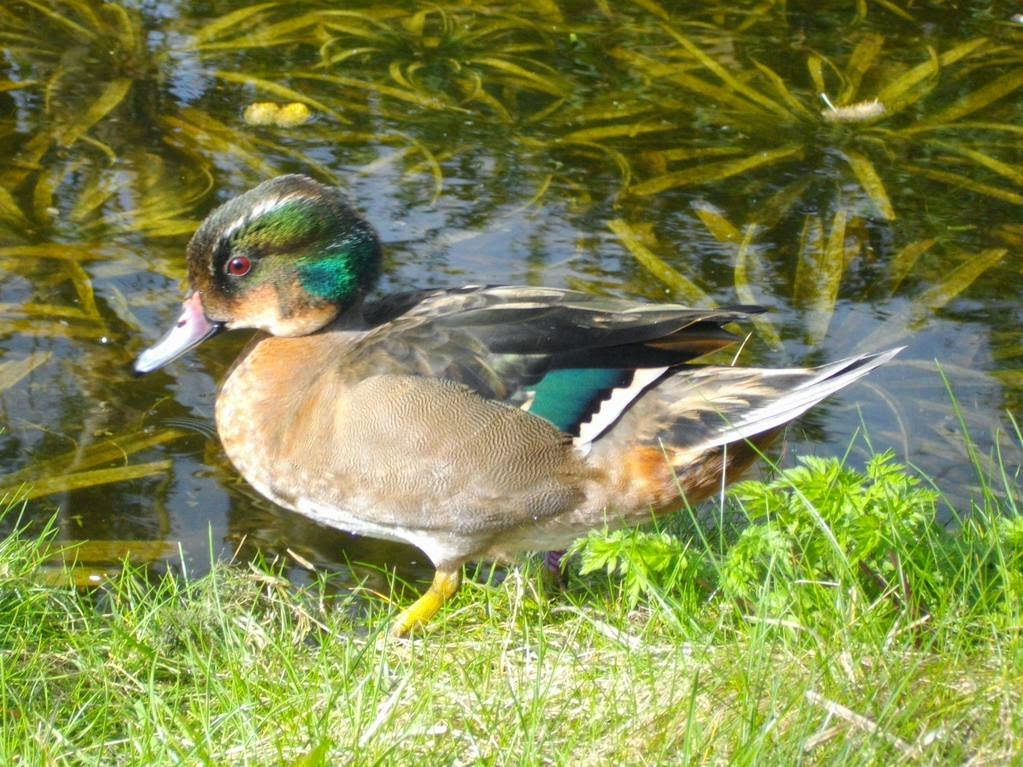
Wood Duck x Bufflehead

captive Wood Duck x Bufflehead hybrid, Netherlands - copyright Joern Lehmhus
(illus. ID: 2437)


The photographer of this bird didn't know its parentage, but Joern points out:
"Wood duck traits are obvious and the other features indicate the second parent to be a short-billed white-flanked and pale- or white-breasted bird.  From bill and eye coloration a dark-eyed, grey-billed bird appears also likely.  All these features point to Bufflehead."


Wood Duck Aix sponsa
Bufflehead Bucephala albeola

Saturday, 6 December 2014

Wood Duck x Aythya sp.

captive? Wood Duck x Aythya sp., Halle (Saxony-Anhalt, Germany), 1st November 2014 - copyright Joern Lehmhus
(photo ID: 1672)


Captive Wood Ducks seem to generate hybrids with a wide variety of duck species so hopefully it will only be a matter of time before we have a good enough understanding of the various Wood Duck x Aythya hybrids to be able to identify individuals like this more precisely.


captive? Wood Duck x Aythya sp. (with Wood Duck; same bird as in photo ID 1672 above), Halle (Saxony-Anhalt, Germany), 1st November 2014 - copyright Joern Lehmhus
(photo IDs: 1673-1674)


Wood Duck Aix sponsa
Pochard sp. Aythya sp.

Sunday, 15 June 2014

Wood Duck x Laysan Duck or Wood Duck x Chestnut Teal

escaped possible Wood Duck x Chestnut Teal or Wood Duck x Laysan Duck hybrid, Roskilde (Denmark), 2007 - copyright Rasmus Strack
(photo ID: 0883)


The identification of this hybrid is unknown.  Wood Duck x Chestnut Teal has been suggested and at the moment we have very little to go on.  It may be the correct ID but further examples of this or other similar hybrids will probably be necessary before we can reach any clear conclusions.

Joern has unearthed a description of another example of a bird identified as Wood Duck x Chestnut Teal hybrid, along with a photo of the mounted specimen (which is unfortunately no longer available), and that one apparently looked rather different.  That might indicate that we need a different solution for this bird and one idea Joern has suggested is Wood Duck x Laysan Duck.


escaped possible Wood Duck x Chestnut Teal or Wood Duck x Laysan Duck hybrid (same bird as in photo ID 0883 above), Roskilde (Denmark), 2007 - copyright Rasmus Strack
(photo ID: 0884)


Wood Duck Aix sponsa
Laysan Duck Anas laysanensis
Chestnut Teal Anas castanea

Friday, 7 March 2014

Common Shelduck x Wood Duck

Common Shelduck x Wood Duck hybrid, River House Restaurant, Stirling (Stirlingshire, UK), 29th December 2013 - copyright Dave Appleton
(photo ID: 0287)


A very distinctive hybrid that looks nothing like either parent species, although it is in fact pretty much intermediate between each parent.  Thanks to Lynn Morag for bringing my attention to this pair of birds (I presume they are male and female) which have been present on the small loch just off the M9 for a few years.  When I visited there were only a small number of wildfowl present and most of them were hybrids - this begs a question as to how they got there - maybe they were unwanted accidents from another collection (many collectors don't like to keep hybrids) donated to the restaurant to entertain their visitors?


 Common Shelduck x Wood Duck hybrid (same bird as in photo ID 0287 above), River House Restaurant, Stirling (Stirlingshire, UK), 29th December 2013 - copyright Dave Appleton
(photo IDs: 0288-0290)


The second bird (below) was much duller, lacking some of the male Wood Duck features showing on the first bird, such as the black vertical bar at the sides of the breast, the horizontal pale flank stripe, so I presume it was a female.


Common Shelduck x Wood Duck hybrid (second individual), River House Restaurant, Stirling (Stirlingshire, UK), 29th December 2013 - copyright Dave Appleton
(photo IDs: 0291-0294)


Common Shelduck Tadorna tadorna
Wood Duck Aix sponsa

Wood Duck x Greater Scaup

captive probable Wood Duck x Greater Scaup hybrid, Oost, Texel (Netherlands), 11th July 2013 - copyright Joern Lehmhus 
(photo ID: 2321) 


In the above photo you can see the dark speculum and upper wing coverts, the secondaries are slightly lighter trowards the base and the secondary tips are clear white as in Wood Duck.  Joern also tells us that a very faint greenish iridescence is sometimes visible on the upper wing.  The only Aythya species present were Greater Scaup and Ferruginous Duck.

captive probable Wood Duck x Greater Scaup hybrid (same bird as in photo ID 2321 above), Oost, Texel (Netherlands), 11th July 2013 - copyright Joern Lehmhus 
(photo ID: 2320)


captive probable Wood Duck x Greater Scaup hybrid (with Red-crested Pochards, Speckled Teal x Ferruginous Duck hybrid, Northern Shovelers, Gadwall and Hooded Merganser; same bird as in photo IDs 2320-2321 above), Oost, Texel (Netherlands), September 2010 - copyright Joern Lehmhus 
(photo IDs: 0706-0710)


When the last set of photos above were taken this bird did not have the pale grey tail feather that was present in February 2012, as seen in the photo below.


captive probable Wood Duck x Greater Scaup hybrid (same bird as in photo IDs 2320-2321 and 0706-0710 above), Oost, Texel (Netherlands), February 2012 - copyright Joern Lehmhus
(photo IDs: 0648-0652)


Wood Duck Aix sponsa
Greater Scaup Aythya marila

Wood Duck x Northern Pintail

possible intersex female Wood Duck x Northern Pintail hybrid, Holkham Park (Norfolk, UK), 4th February 2012 - copyright Dave Appleton
(photo ID: 0302)


This was a difficult ID!  Assuming it was a male no two species in combination seemed to quite add up.  The head shape strongly recalled Wood Duck hybrids, some features seemed to suggest Mallard but the bill colour, among other things, was wrong for Wood Duck x Mallard.  The possibility of it being a trigen (three species involved) was considered, but still nothing resolved it in a satisfactory way.  Eventually we hit on the idea that it might be an intersex female - the pale cheeks and throat are often present on intersex birds and the brown plumage (especially on the back and scapulars) can then be explained as female-type feathers rather than having to find a parent species with brown here.  Hybrids seem more prone to intersex so this is not implausible.  So far though, the proposed identification is only tentative - maybe when we have more experience of similar hybrids we will be able to firm it up more.  One thing we have learned is that the chestnut reddish colour under the tail is typical of several Wood Duck hybrids (and also some others, such as dabbling x diving duck combinations).


possible intersex female Wood Duck x Northern Pintail hybrid, Holkham Park (Norfolk, UK), 4th February 2012 - copyright Dave Appleton
(photo IDs: 0303-0308)


Wood Duck Aix sponsa
Northern Pintail Anas acuta

Wood Duck x White-cheeked Pintail

Wood Duck x White-cheeked Pintail hybrid, East Ruston Vicarage (Norfolk, UK), 2nd April 2015 - copyright James Emerson
(photo ID: 2162)


I had a feeling these two hybrids were probably Wood Duck x White-cheeked Pintail but Joern was much more confident: "It is 100% sure this cross, head pattern, tail, speculum, bill, everything perfect match with birds of known parentage."


Wood Duck x White-cheeked Pintail hybrids (including the above bird in photo ID 2162), East Ruston Vicarage (Norfolk, UK), 2nd April 2015 - copyright James Emerson
(photo ID: 2163)


And here's an illustration from Joern that was based on photos of three different individuals.


Wood Duck x White-cheeked Pintail hybrid - copyright Joern Lehmhus
(plate ID: 0739)


Wood Duck Aix sponsa
White-cheeked Pintail Anas bahamensis

Wood Duck x Mallard

Wood Duck x Mallard hybrids, Petaluma (California, USA), 31st January 2012 - copyright Matt Brady
(photo ID: 2125)


Joern has combined his extensive experience and drawing skill to provide a handy plate showing some of the variation that can be seen in this hybrid.

male Wood Duck x Mallard hybrids, based on different males from Spain, Switzerland, Germany and North America - copyright Joern Lehmhus
(illus. ID: 0758)


None of the birds above show a white vertical line at the side of the breast such as is found in drake Wood Ducks, but the next one does...


Wood Duck x Mallard hybrid, Radipole Lake (Dorset, UK), 17th March 2016 - copyright Philip Ridsdale
(photo IDs: 3096-3098)


Not content with just the males, Joern has also done a nice plate illustrating variation among females of this hybrid:

female Wood Duck x Mallard hybrids - copyright Joern Lehmhus
(illus.ID: 0759)


Joern has also had an opportunity to study juveniles of this hybrid in captivity.  First off though, here is a male, presumably in eclipse plumage.

captive male Wood Duck x Mallard hybrid, Germany, end of August 2008 - copyright Joern Lehmhus
(photo ID: 0780)


And here are the juveniles at different times


captive juvenile Wood Duck x Mallard hybrids (with Wood Duck in last photo), Germany, end of July 2008 - copyright Joern Lehmhus
(photo IDs: 0776-0779)


captive juvenile Wood Duck x Mallard hybrids (with Wood Duck in last photo), Germany, end of August 2008 - copyright Joern Lehmhus
(photo IDs: 0781-0785)


By the end of September these juveniles had acquired much of their adult plumage, as shown in the following photos.


 captive first-winter Wood Duck x Mallard hybrids (with Wood Duck in last photo), Germany, end of September 2008 - copyright Joern Lehmhus
(photo IDs: 0786-0791)


Stephen reported one drake Wood Duck x Mallard hybrid accompanied by two unidentified females (one of which is shown below, the other apparently being similar).  The female compares well to the ones Joern has illustrated and photographed so I think it's safe to say they are also Wood Duck x Mallard.


Wood Duck x Mallard hybrids, Fishers Green (Essex, UK), 28th December 2014 - copyright Stephen Prower
(photo IDs: 3183-3185)


Wood Duck Aix sponsa
Mallard Anas platyrhynchos