Showing posts with label Tadorna ferruginea. Show all posts

Saturday, 28 February 2015

Ruddy Shelduck x Common Shelduck

Ruddy Shelduck x Common Shelduck hybrid, Rutland Water (Rutland, UK), May 2010 - copyright Steve Graby
(photo ID: 1947)


Some examples of this hybrid look much closer to Ruddy Shelduck in appearance, but birds like this one, superficially resembling Australasian Shelduck, are quite typical.


Ruddy Shelduck x Common Shelduck hybrid (same bird as in photo ID 1947 above; with Egyptian Goose), Rutland Water (Rutland, UK), May 2010 - copyright Steve Graby
(photo IDs: 1942-1946)


Here is another bird, rather similar to the last but with perhaps greyer flanks.

Ruddy Shelduck x Common Shelduck hybrid, Thorpe Park (Surrey, UK), 23rd January 2014 - copyright David Darrell-Lambert
(photo ID: 2688)


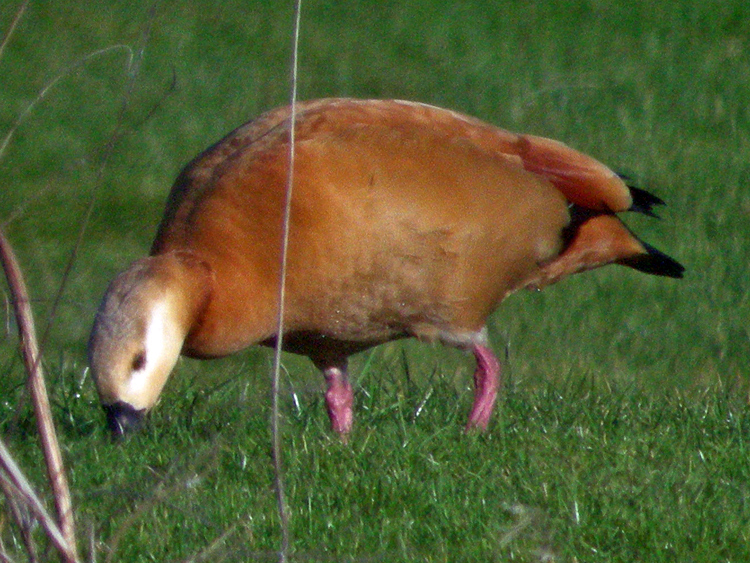
The next bird's identity is not certain.  I am struggling to come up with any alternative, though I have not seen an example looking quite like this before.  Joern also finds it odd and hasn't seen a Shelduck hybrid like it before, so we must retain some doubt over its identity.  Nevertheless my rationale for feeling that Ruddy x Common Shelduck is the best-fitting (if imperfect) solution is as follows...

The extensive orange colouration presumably points to Ruddy or South African (Cape) Shelduck and the fact that this extends on to the head (and the breast and vent are quite dark) seems to point to Ruddy rather than South African.  The legs have a strong pink element which probably counts out any dark-legged species for the second parent, but leaving Common Shelduck (among others).  Most examples of Ruddy Shelduck x Common Shelduck hybrids look quite different, often showing a white collar and often showing grey flanks, but both of those features can be absent on this hybrid.  Other ideas are welcome though - please comment if you have any thoughts.

Something I didn't notice when I first looked at these photos is that there is a tiny patch of pink on the culmen of the bill, and also a slight hint of a raised knob at the base of the bill.  Both of these features would be compatible with Common Shelduck involvement.

One possible explanation for its unusual appearance is that it could be a backcrossed bird (Ruddy Shelduck x Common Shelduck hybrid as one parent, Ruddy Shelduck the other).  But Ian Gereg has raised another possibility.  There is a new colour mutation of Ruddy Shelduck called 'red' known in captivity which apparently looks like this bird.  At the moment we are not clear how this mutation is produced, but we suspect that it does not come simply from mutation in Ruddy Shelduck and no input from Common Shelduck, but perhaps the Common Shelduck input was some generations back?  We hope to find out more - if you are any clearer on the origin of this "mutation" then please get in touch.


captive probable Ruddy Shelduck x Common Shelduck hybrid (perhaps backcrossed; with Ruddy Shelduck), private collection (Staffordshire, UK), 29th March 2016 - copyright Brian Harris
(photo IDs: 2794-2798)


The next one is probably the same bird.

captive probable Ruddy Shelduck x Common Shelduck hybrid (perhaps backcrossed; with Ruddy Shelduck), JCB Lakes, Rocester (Staffordshire, UK), 30th March 2016 - copyright Philip Ridsdale
(photo ID: 3091)


Ruddy Shelduck Tadorna ferruginea 
Australian Shelduck Tadorna tadornoides
Common Shelduck Tadorna tadorna

Monday, 26 January 2015

Ruddy Shelduck x South African Shelduck

probable Ruddy Shelduck x South African Shelduck, Wretham (Norfolk, UK), 17th February 2017 - copyright Dave Appleton
(photo ID: 3044)


This bird looked a lot like a Ruddy Shelduck, but it didn't seem to be quite right. On close inspection I noticed the bird had dark vermiculations on its rear flank feathers and rear upper scapulars - features that should not occur on pure Ruddy Shelduck.  It also had a grey spot in the middle of the crown. I've seen a few Ruddy Shelducks with some grey on the head and wondered about their genetic purity, but this one was more extreme than most.  South African Shelduck (often known as Cape Shelduck) has a grey head of course, and also shows dark vermiculations where this bird had.  It is perhaps hard to be completely sure that it isn't a second or subsequent generation backcrossed hybrid with a different Shelduck species, but as South African and Ruddy often come together in collections I suspect this is the more likely and simplest solution.


probable Ruddy Shelduck x South African Shelduck (same bird as in photo ID 3044 above), Wretham (Norfolk, UK), 17th February 2017 - copyright Dave Appleton
(photo IDs: 3045-3053)


The poor photos of the next bird don't offer many clues but in the field though it struck me as being distinctly dark and chestnutty compared to Ruddy Shelduck, especially towards the rear where there seemed to be blackish shading.  This reminded me of South African Shelduck.  On the head a grey patch was present just behind/above the eye and a smaller less distinct grey patch in front of the eye.  Not visible from the side but more obvious from the front when its head was down was a small darker grey patch on the centre of the crown between the eyes.  It was a male, but lacked any hint of a dark neck collar - not sure if pure Ruddy Shelduck always shows this in January or not?

This bird looked extremely similar to the one above and although separated by just over 2 years, the sites are only 17.4 miles apart and I think it's quite likely that both involved the very same bird.  This bird was seen with Egyptian Geese, the one above was paired to an Egyptian Goose... maybe this pair is responsible for the various records of what look like Egyptian Goose x Ruddy Shelduck hybrids around the county in recent months?


probable Ruddy Shelduck x South African Shelduck (with Egyptian Geese), Bittering, 25th January 2015 - copyright Dave Appleton
(photo IDs: 1785-1786)


Interestingly another apparent Ruddy Shelduck x South African Shelduck was recently photographed elsewhere in the county.  It was identified as Ruddy Shelduck but this bird, a female this time, showed dark inner webs to the tertials which should be a South African feature.

All this makes me wonder about some Ruddy Shelducks I've seen in the past.  At a collection containing several South African Shelducks and several Ruddy Shelducks (plus an Australian Shelduck and a hybrid Ruddy x Australian) I noticed some of the Ruddies showed a little grey in the head.  Although I was not aware that pure Ruddy Shelduck could show this I noted that there were no other features suggesting South African influence so felt there was insufficient evidence to point to them being hybrids.  Subsequently a similar escaped bird has been at my local patch, again not showing sufficeint anomalies to make me feel it should be a hybrid.  Now I'm wondering though - are these birds with grey in the head really pure Ruddy Shelducks, or could they have South African Shelduck influence (not necessarily F1 hybrids)?

Here is the escaped bird - this one shows a grey patch on the centre of the crown, a bit like the Bittering bird above, though less clear.  In these photos it also seems to show a little greyish patch on the ear-coverts and slightly greyish out webs of the tertials.  Subsequent photos of the same bird (probably taken after a moult) don't show these features.


escaped Ruddy Shelduck or possibly Ruddy Shelduck x South African Shelduck hybrid, Beetley (Norfolk, UK), 27th May 2013 - copyright Dave Appleton
(photo IDs: 1787-1788)


By the time the next photos were taken the patch on the crown remained but there is no sign of any grey elsewhere on the head or on the tertials.


escaped Ruddy Shelduck or possibly Ruddy Shelduck x South African Shelduck hybrid (same bird as in photo IDs 1787-1788 above), Beetley (Norfolk, UK), 2nd March 2014 - copyright Dave Appleton
(photo IDs: 1789-1791)


The next birds are even more subtle and again I am not sure if the slight hint of grey behind the eye is within range of variation for pure Ruddy Shelduck or not.  With so many South African and Ruddy Shelducks mixing at this collection there is plenty of potential for hybrids, but there were no apparent F1 Ruddy Shelduck x South African Shelduck hybrids present.  Are these birds backcrossed hybrids, or just Ruddy Shelducks?

captive Ruddy Shelduck or possibly Ruddy Shelduck x South African Shelduck hybrid, Grange-over-Sands (Cumbria, UK), 27th December 2012 - copyright Dave Appleton
(photo ID: 1792)


captive Ruddy Shelduck or possibly Ruddy Shelduck x South African Shelduck hybrid, Grange-over-Sands (Cumbria, UK), 28th December 2011 - copyright Dave Appleton
(photo IDs: 1793-1794)


Ruddy Shelduck Tadorna ferruginea
South African Shelduck Tadorna cana

Friday, 7 March 2014

Ruddy Shelduck x Australian Shelduck

captive presumed Ruddy Shelduck x Australian Shelduck, Grange-over-Sands (Cumbria, UK), 28th December 2011 - copyright Dave Appleton
(photo ID: 0280)


The extensive orange plumage of this bird points to Ruddy Shelduck or Cape Shelduck as one parent, and the orange tones on the head suggest Ruddy over Cape (both were present in the collection).  Although some Ruddy Shelduck x Common Shelduck hybrids have grey vermiculated body feathers the darkness of this one suggested either Paradise Shelduck or Australian Shelduck.  The contrastingly clean orange breast is probably indicative of Australian rather than Paradise, and the fact that a single male Australian Shelduck was in the same collection lends weight to this theory.


captive presumed Ruddy Shelduck x Australian Shelduck, Grange-over-Sands (Cumbria, UK), 28th December 2011 - copyright Dave Appleton
(photo IDs: 0275-0279)


A year later it was still present, though I couldn't see the Australian parent any longer.


captive presumed Ruddy Shelduck x Australian Shelduck, Grange-over-Sands (Cumbria, UK), 27th December 2012 - copyright Dave Appleton
(photo IDs: 0281-0286)


Ruddy Shelduck Tadorna ferruginea
Australian Shelduck Tadorna tadornoides

Egyptian Goose x Ruddy Shelduck

Egyptian Goose x Ruddy Shelduck hybrid, Hannover Zoo (Lower Saxony, Germany), 24th October 2010 - copyright Joern Lehmhus
(photo ID: 0583)


In an earlier draft I mistakenly captioned these birds as captive, but Joern has clarified that they are the offspring of a captive pinioned male Ruddy Shelduck and a feral fully-winged female Egyptian Goose.  The hybrid young were raised by the pair and never caught and handled so far as we know.  They behave like the feral Egyptian Geese that also frequent the zoo, not overly shy, but not tame.  The remaining hybrid is not confined to the zoo but frequents other wetland areas around Hannover.

Joern draws our attention to the intermediate colours on this individual, the dirty pink legs and the broad, dark rusty-brown neck band.  The legs are longer than in Ruddy Shelduck, the bill shape is intermediate and the iris is dark.  Its presumed parents are shown in one of the photos below.


Egyptian Goose x Ruddy Shelduck hybrid (with Egyptian Goose and Ruddy Shelduck; same bird as in photo ID 0583 above), Hannover Zoo (Lower Saxony, Germany), 24th October 2010 - copyright Joern Lehmhus
(photo IDs: 0579-0581)


As you can see in the above photo, the thin black stripe of Egyptian Goose on the white greater coverts is also expressed in this hybrid.

A second individual (below) was more like Ruddy Shelduck in overall appearance but this bird also shows dirty pink legs and the dark rusty brown neck band (not black as in Ruddy Shelduck)

Egyptian Goose x Ruddy Shelduck hybrid (second individual), Hannover Zoo (Lower Saxony, Germany), 24th October 2010 - copyright Joern Lehmhus
(photo ID: 0582)


Joern believes the next photos show the same bird.


Egyptian Goose x Ruddy Shelduck hybrid (with Ruddy Shelduck), Hannover Zoo (Lower Saxony, Germany), 25th January 2014 - copyright Joern Lehmhus 
(photo IDs: 1605-1606)


Joern draws attention to the violet speculum on the next photo - not something you might expect on a hybrid between two species that normally show green speculums (although in both species the green is irridescent and can sometimes appear violet), but I'm reminded of Tufted Duck x Ring-necked Duck hybrids which typically show green head sheen where both parents have purple head sheens.  As above, this bird shows the dark bill of a Ruddy Shelduck and pink legs more like those of an Egyptian Goose.  In this image you can also see the thin black stripe on the wing-coverts in front of the speculum which is present on Egyptian Goose but not Ruddy Shelduck.

Egyptian Goose x Ruddy Shelduck hybrid, Hannover (Lower Saxony, Germany), 26th October 2014 - copyright Joern Lehmhus 
(photo ID: 1675)


The next bird was photographed looking into the sun, so the images aren't the best.  What was presumably the same bird was reported nearby as a Ruddy Shelduck and indeed on a casual look that mistake would be understandable.


Egyptian Goose x Ruddy Shelduck hybrid (with Egyptian Geese), Burnham Market (Norfolk, UK), 21st September 2016 - copyright Dave Appleton 
(photo IDs: 3108-3113)


The next bird was initially reported as a hybrid but later by more experience birders as a pure Ruddy Shelduck, but in this case it was the original finder who was correct.  The pink legs in a photo were a give-away but apart from that it did look quite a lot like a Ruddy Shelduck although different photos showed either a buffy-grey belly or buffy-grey mantle (but not both on the same image suggesting it might just be the light).  When I saw the bird in the flesh I was surprised at how orange it looked - at some angles the sides and back looked a little buffish but on good side-on views it just looked orange like a Ruddy Shelduck.  I started to wonder if I was imagining the structural and postural anomalies and whether it might indeed be a pure Ruddy Shelduck after all, with some kind of mutation giving it pink legs.  But it was a hybrid - although the tone of the back and body varied according to the angle of the bird it did look consistently paler than would be expected on a pure Ruddy Shelduck.  The head looked a lot like other Egyptian Goose x Ruddy Shelduck hybrids and that slightly Egyptian Goose-like gait was certainly there.  When I studied the photos what I thought was a black collar in the field turned out to be more reddish than I'd realised, and was quite broad with a diffuse upper border further suggesting Egytpian Goose influence.  Finally the white thighs might be significant - shown by some other Egyptian Goose x Ruddy Shelduck hybrids whereas I think they're always at least partly orange on pure Ruddy Shelduck.  The bird is paired to and has been energetically displaying to an Egyptian Goose so it shall be interesting to see if they produce backcrossed hybrid offspring - currently I am not sure if this cross-generic hybrid can be fertile or not.


Egyptian Goose x Ruddy Shelduck hybrid (with Egyptian Goose), Ringland (Norfolk, UK), 14th February 2017 - copyright Dave Appleton 
(photo IDs: 3054-3062)


It is worth noting that there is at least one apparent Ruddy Shelduck x South African Shelduck hybrid at large in Norfolk and paired to an Egyptian Goose.  It is quite possible that the two Norfolk birds shown above are in fact trigens: Egyptian Goose x (Ruddy Shelduck x South African Shelduck)!


Egyptian Goose Alopochen aegyptiaca (formerly Alopochen aegyptiacus)
Ruddy Shelduck Tadorna ferruginea
South African Shelduck Tadorna cana