Sunday, 21 February 2016

Recent updates

proven Common Redstart x Whinchat hybrid, Lista Bird Observatory (Vest-Agder, Norway), 18th September 2013 - copyright © Jonas Langbråten
(photo ID: 2594)


Here's another of our regular posts letting you know what pages have been updated in the project recently.  As always, a big thanks to all who have contributed photos and/or insights, and if you haven't done yet or have more to offer then please get in touch.  You can comment on any thread if you have anything to say about the hybrids or topics covered, and if you have any photos you would be willing for us to use, please let us know (e.g. by emailing us).

The recent updates are summarised below but remember you can find an index list linking you to ALL the bird hybrids featured so far here:
And an index list of all the bird hybrid topics covered so far here:


So, the recent updates are:


New Bird Hybrid pages added for:

New photos added to:

Text updated in:


Don't forget you can now follow us on Twitter at @BirdHybrids

Enjoy browsing - and please do contribute where you can!

White-cheeked Pintail x Chestnut Teal

possible White-cheeked Pintail x Chestnut Teal hybrid, Victoria Park (Surrey, UK), 3rd November 2012 - copyright David Darrell-Lambert
(photo ID: 2700)


The identification of this bird is not easy and so far we have not reached a confident conclusion.  Provisionally I've labelled it as possible White-cheeked Pintail x Chestnut Teal as of all the ideas that have been presented so far this one seems to me to be the best, but we are by no means sure.

The rather long pointed tail with white sides suggests White-cheeked Pintail to me, though there are other species with relatively long tails and other species with white edges to the tail, so this is not a certainty.  The pale cheeks fit with that too, though of course there are many other hybrids that show pale cheeks, so this is not a strong supporting factor.  The brown body plumage suggests to me one of the ducks that lack bright body colours, which again fits White-cheeked Pintail (among other species), but of course we do not know that this bird is fully adult, or if it has completed its post-eclipse moult, or indeed if it is intersex.  So White-cheeked Pintail is a tentative starting point for me, not a conclusion.

If right, then the second parent must have black under the tail and a green head.  Probably a wholly green head as the green looks quite extensive, though hybrids involving Wigeon or Teal have also been suggested.  We have seen Wood Duck x White-cheeked Pintail hybrids recently and these have looked quite different, but one of my first ideas was Mallard x White-cheeked Pintail.  But this idea did not convince me, or others I asked.  Mallard hybrids usually show some hint of the curved central tail feathers, whereas this shows nothing of that.  A Chiloe Wigeon x White-cheeked Pintail hybrid looked very different with, among other things, very different pattern to the tertials and scapulars.

It was Joern who first suggested White-cheeked Pintail x Chestnut Teal, though he has been clear that he is not sure and some things seem wrong for this ID.  But the tertials and scapulars of Chestnut Teal are rather close to this bird, and the pattern of the flanks (if not the colour) could easily lead to a pattern like the one shown by this bird.  And it has a green head and black vent of course, and the bill is not dissimilar either.  But should we not expect to see chestnut colour on the body if Chestnut Teal was involved?  Certainly some of their hybrids show chestnut on the body.  Well, there's a photo of a Cape Teal x Chestnut Teal hybrid in one of the Gillham books (Hybrid Ducks: the 5th contribution towards an inventory, plate 68) and that shows only a hint of chestnut on its breast, not at all on the flanks - so rather like this bird in that respect.  We might have expected to see a redder eye on a Chestnut Teal hybrid, but at least it is not darker than that of White-cheeked Pintail (it's actually quite similar to White-cheeked Pintail's eye colour I think).

We've considered other ideas too, involving Teal, Wigeon and even Black Duck, but for me at this point White-cheeked Pintail x Chestnut Teal is the best fit.  That doesn't mean it's right though, so please get in touch if you can help clear this mystery up!


possible White-cheeked Pintail x Chestnut Teal hybrid (same bird as in photo ID 2700 above), Victoria Park (Surrey, UK), 3rd November 2012 - copyright David Darrell-Lambert
(photo IDs: 2701-2702)


White-cheeked Pintail Anas bahamensis
Chestnut Teal Anas castanea

Wednesday, 17 February 2016

Yellow-legged Gull intergrades

possible Yellow-legged Gull intergrade, Hyde Park (London, UK), 16th December 2006 - copyright Dave Appleton
(photo ID: 1567)


The Azorean form of Yellow-legged Gull (atlantis) is sometimes considered to be a distinct species (sometimes known as Azorean Gull), and appears to be a rare vagrant to north-west Europe with several credible claims from the UK and Ireland in recent years.  The individual shown here showed many features consistent with this taxon but some observers felt that not everything was quite right.  Specifically they felt that the tone of the upperparts was a bit too much like michahellis Yellow-legged Gull and the structure was not as it should be.  It is possible that it was an odd atlantis, and it is possible that it was a Yellow-legged Gull originating from one of the other Atlantic island populations, but perhaps an intergrade or hybrid between the two might be the most satisfactory explanation.


possible Yellow-legged Gull intergrade (same bird as in photo ID 1567 above), Hyde Park (London, UK), 16th December 2006 - copyright Dave Appleton
(photo IDs: 1567-1570)


Yellow-legged Gull Larus michahellis  
Azorean Gull Larus (michahellis) atlantis

Wednesday, 3 February 2016

Herring Gull x Caspian Gull

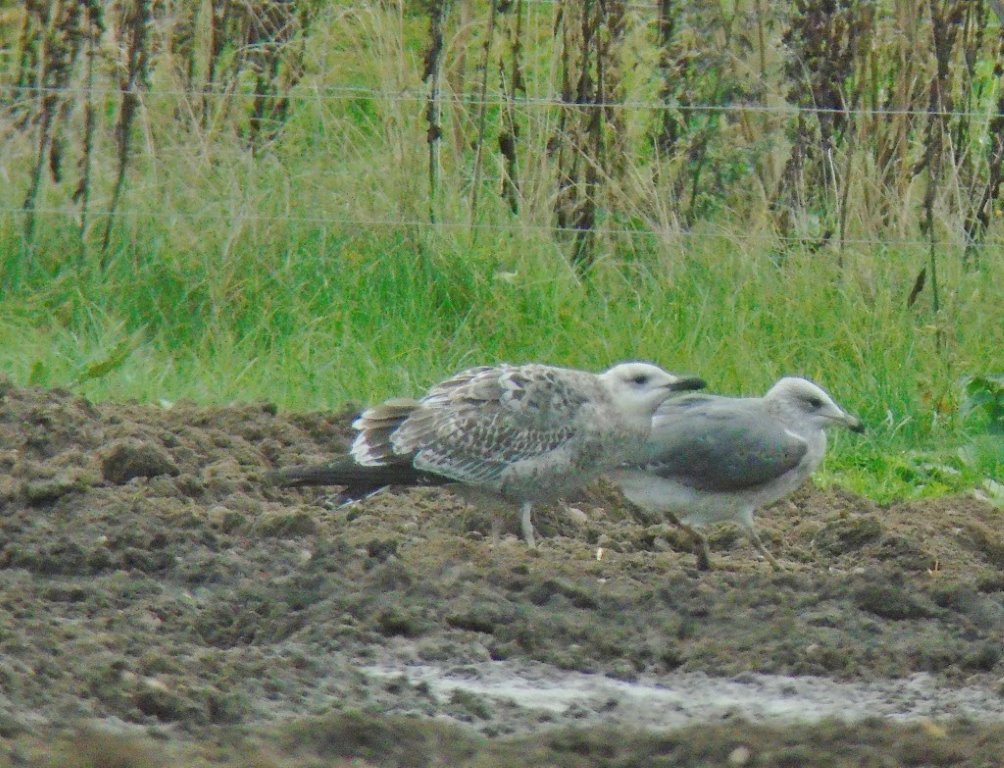
probable Herring Gull x Caspian Gull hybrid, Millennium Green, North Hykeham (Lincolnshire, UK), 22nd September 2015 - copyright Dean Nicholson
(photo ID: 2652)


Dean thought this bird was going to be a first-winter cachinnans (Caspian Gull) when he first saw it but after a longer view he started to have doubts and suspect mixed genes.  He writes:
"Size and proportions were spot on for cachinnans, head and bill shape and position of eye all good, long primaries and tertial pattern was absolutely perfect for cachinnans and the whitish head with subtle mask around eye also fitted cachinnans nicely...  I never particularly liked the well barred greater coverts but occasionally some pure Caspian can show this pattern but generally it is much more a feature of young Herrings.  I was more concerned by the retarded state of moult... it was still in full juvenile plumage which would be remarkable for a Caspian Gull on this date and should really be showing several second generation scapulars now as well as some renewed coverts.  The oak-leafed patterned scapulars were also a bit more Herring-like than I would have liked although when it flapped the underwing/axillaries looked nice and white thus Caspian-like.  When I got home I forwarded the pics to my usual gull contacts and they all agreed that this was no pure Caspian and was in all probability a Caspian x Herring which is a common hybrid pairing in western Europe now (especially East Germany and Poland) where Caspians are spreading west."

probable Herring Gull x Caspian Gull hybrid (same bird as in photo ID 2652 above), Millennium Green, North Hykeham (Lincolnshire, UK), 22nd September 2015 - copyright Dean Nicholson
(photo ID: 2653-2654)


Here is another Caspian look-alike.  Dean tells us:
"I initially called it a Caspian when I first saw it at range in heat haze but over the following days when I saw it at closer range I realised it wasn’t quite right (slightly odd tertials, dark underwing/axillaries, random scapular moult), so I circulated to my gull contacts for opinion and although there is a lot of guesswork involved with such birds, the general consensus was that it is more than likely a Caspian x Herring hybrid.  A common mixed pairing on East Germany and Poland."


probable Herring Gull x Caspian Gull hybrid, Spalford (Nottinghamshire, UK), 1st November 2016 - copyright Dean Nicholson
(photo ID: 2961-2968)


Herring Gull Larus argentatus
Caspian Gull Larus cachinnans

Thursday, 21 January 2016

Yellow-billed Pintail x Marbled Teal

The bird previously posted here as a presumed Yellow-billed Pintail x Marbled Teal hybrid has now been moved back to the Yellow-billed Teal x Marbled Teal page.  Further input on this bird's ID suggest that this is the more likely identification.  Apologies for the confusion.


Yellow-billed Pintail Anas georgica
Yellow-billed Teal Anas flavirostris
Marbled Teal Marmaronetta angustirostris

Wednesday, 20 January 2016

Yellow-billed (Speckled) Teal x Marbled Teal

probable Yellow-billed Teal x Marbled Teal hybrid, Rollesby Broad (Norfolk, UK), 24th January 2016 - copyright Dave Appleton
(photo ID: 2612)


I suppose in some ways it's a bit embarrassing that I started off thinking this was a Yellow-billed Teal x Marbled Teal hybrid, then saw the bird in the flesh, did some research and analysis before settling on Yellow-billed Pintail x Marbled Teal hybrid instead, but now find myself persuaded that it is (probably) a Yellow-billed Teal x Marbled Teal hybrid after all.  But then again that's the point of the Bird Hybrids project - sharing thoughts, pooling knowledge and learning collectively, knowing that along the way we're bound to make the odd mistake.  And I've certainly learned a few things in the process of working this one out - for example that Marbled Teals can have yellow at the base of the bill... did you know that?  I'm hugely grateful to Joern Lehmhus for his input on this bird - his expertise with hybrid ducks is surely unrivalled!

These are the features we have considered in relation to this bird:
  • The bushy 'mane', or loose mop of feathers at the back of the neck, is important.  Some have suggested that this bird is a Speckled Teal (Yellow-billed or Andean Teal, though presumably they mean Yellow-billed) - I do not believe any form of Speckled Teal can show such a bushy 'mane' as shown on this bird (possibly they may show a slight lift of the nape feathers as can many Teal species, but this is not the same as here).  For me this is the clearest indication that Marbled Teal is involved.  Wood Duck, Falcated Duck and to a lesser extent various other Teal species may show a maned effect too, but not the narrowly bushy/tufty feature shown by our bird here, which is very much like that of Marbled Teal.  Apart from Marbled Teal, I think Cape Teal and Crested Duck are the only other species (correct me if I am wrong) that come close to having a mane like this. 
  • With no red on the bill (as well as for other reasons) I think we can rule out Cape Teal involvement easily.
  • The dark band through the eye was more obvious in the field than it seemed in the first photos.  This is supportive of Marbled Teal involvement, though it is a features shared with Crested Duck (as well as various other species to some extent).
  • The eye is fairly dark, lacking any obvious red or yellow tones.  If Crested Duck had been involved we might perhaps have expected to see something of the red eye come through on a hybrid.  I would hesitate to rule out a red (or yellow) eyed species being involved, but eye-colour is often intermediate in hybrids.
  • That yellow on the bill, restricted to near the base of the lower part of the upper mandible: the pattern recalls Yellow-billed Teal and Yellow-billed Pintail, though conceivably perhaps it could appear on a hybrid between a more extensively yellow-billed species and a dark-billed species like Marbled Teal.  But a complete surprise to me was when Joern pointed out that pure Marbled Teal can show this pattern as well - here are a couple of examples: a little bit showing on this bird and more obvious on this bird.  So we cannot conclude from this that the second parent was definitely a yellow-billed species, although the two species with similar pattern of yellow would seem like a good starting point.  Note that the yellow on the hybrid is diffusely edged and less extensive than we would expect to see on a pure Yellow-billed Teal, further evidence that this is not a pure Yellow-billed Teal.
  • This bird has a clear pale bluish subterminal band on the bill, a feature shared with Yellow-billed Pintail but not really with Yellow-billed Teal.  This was one of the features that most convinced me that Yellow-billed Pintail was involved rather than Yellow-billed Teal, however Joern has come up with a different, and better, explanation... it is also a feature shared by some Marbled Teals!  I did not know that, but again Joern provided some links to birds showing this (here, here and here).
  • Scapular shape - I had already backed down on the comments I made last week about the shape of the scapulars being long and pointy on oxyptera Yellow-billed Teal, which were based on rushed research.  It seems that some examples of Yellow-billed Teal show elongated pointed scapulars while many do not.  Moreover some examples of Yellow-billed Pintail do too, while others do not.  The references I have access to don't seem to offer an explanation but presumably it is down to gender, age or season?  But for now, other than recognising that our bird's scapulars are not pointy (though the rear ones are a little on the long side), I'm not sure this feature helps much with the ID.
  • The dark centres to the rear scapulars on the hybrid extend in a point along the feather shaft towards the tip.  That is the case on some images of Yellow-billed Pintail (examples that also have elongated pointed scapulars) but may also be the case on those Yellow-billed Teals that have similar shaped feathers (not clear in the photos I've checked).  I am not clear if this has any relevance to our bird's ID.
  • The rear scapulars show broad pale tips (much broader than the pale edges to the same feathers).  My earlier use of 'globular' to describe these pale tips was an exaggeration, but nevertheless this feature is unusual and is presumably a product of the Marbled Teal involvement. No form of Speckled Teal should show such broad tips to the scapulars, so this further rules out pure Yellow-billed Teal.
  • The tertials are plain lacking any pale edges.  This is fairly unusual for most species (and would again be wrong for pure Yellow-billed Teal) but is normal for Marbled Teal, so presumably inherited from that species.
  • The flank feathers have dark centres with broad pale fringes.  Marbled Teal shows broad pale tips, but not pale edges to the sides of the feathers.  Yellow-billed Teal has pale plain flanks at least from the mid flanks backwards, so I did not expect to see this pattern in a Marbled x Yellow-billed Teal hybrid.  Yellow-billed Pintail on the other hand has dark-centred flank feathers with pale edges, so this seemed a more logical answer.  However, the fore-flanks of Yellow-billed Teal have a similar pattern and Joern advises that you see a similar effect on Marbled Teal x Ferruginous Duck hybrid.  So it seems that the flank pattern need not rule out Yellow-billed Teal as I had supposed.  Perhaps the flank pattern is an ancestral feature of Yellow-billed Teal, obscured in the species itself but expressed in their hybrids?  The closely related (but not yellow-billed) Andean Teal shows pale edged flank feathers.
  • The above discussion of flank feathers applies equally to the uppertail-coverts.
  • I suggested that the tail protruded fruther beyond the tail-coverts than it does on either Marbled Teal or Yellow-billed Teal, concluding that this added weight to Yellow-billed Pintail being the secone parent, rather than Yellow-billed Teal.  Having looked at more images of Marbled Teal I am backing down on this. Sure, the tail is longer than on Yellow-billed Teal, but I'm not so sure that it is longer than on Marbled Teal, in which case this does not necessarily require the second parent to be the Pintail rather than the Teal.
  • Murray's photo of the open wing seems to show a narrow whitish bar at the base of the speculum and broader whitish tips to the secondaries.  Marbled Teal has a plain wing so I figured that this pattern must come from the yellow-billed parent, and that the pattern matched Yellow-billed Pintail much better.  On Yellow-billed Teal the inner bar is broader and browner than the narrow white outer bar.  However, the wing is in shadow in this photo and so although it was reasonable to take this as a feature supporting Yellow-billed Pintail involvement, it would need a clearer view before I could use it to argue against Yellow-billed Teal involvement if other features point that way.  It does however help rule out Crested Duck involvement, which, with a similar head tuft and dark eye-band, could have been considered as an alternative to Marbled Teal.
  • In my argument for this bird having Yellow-billed Pintail involvement I did acknowledge that the contrastingly gingery tones to the edges of the upper scapulars was reminiscent of Yellow-billed Teal.  Actually all the scapulars' edges share the same colour tones but as the lower scapulars are larger the more extensive dark centres offset the overall colour, leaving the upper scapulars looking brightest.  I argued that although this was brightest on the upper scapulars, the colour extended on to the sides of the breast, which, I said, it does not on Yellow-billed Teal.  Joern rightly pointed out that the contrast is not shared by either Marbled Teal or Yellow-billed Pintail, implying that this feature does indeed support Yellow-billed Teal as a parent.  Moreover I have since noticed that on some Yellow-billed Teal images the warm tones do in fact continue on to the sides of the breast to some extent, so my argument against this does not stand up to scrutiny.
  • I did already withdraw an earlier comment about the breast pattern being more barred and less spotted on the hybrid compared to Yellow-billed Teal.  That comment was made before I'd seen the bird in the flesh and it turned out not to be as clear as I had thought when making it.
  • One further feature that helped convince me that Yellow-billed Pintail was the parent rather than Yellow-billed Teal was the leg colour. Marbled Teal, Yellow-billed Teal and Yellow-billed Pintail are all supposed to show grey legs.  So far as I knew the first two always do, but Yellow-billed Pintail, contrary to the text in the Helm guide to Wildfowl (Madge & Burn), sometimes show greenish legs (quite a few photos online involving both subspecies).  The legs of the hybrid are slightly dull greenish grey, so I thought that could be Yellow-billed Pintail influence.  However one of Joern's links to Marbled Teals with yellow on the bill shows a bird with clearly greenish legs, so the green colour on the legs could in fact have come from Marbled Teal.
  • Finally the overall structure of the bird was something I did not comment on before.  It is a small, Teal-like bird, as would be expected if it were a hybrid between Marbled Teal and Yellow-billed Teal.  This was one of the things that made Joern think the non Marbled parent was more likely a Teal species than a Yellow-billed Pintail, and in hindsight I think that makes perfect sense.
I said before that I welcome comments and corrections as I may have overlooked something, and that proved to be the case!  Further comments are still welcome of course.

Any hybrids involving Marbled Teal appear to be quite scarce. McCarthy's Avian Hybrids of the World only cites Marbled Teal x Ferruginous Duck (though I suspect the upcoming second edition might have more...).  Apart from that I know of a Marbled Teal x Ringed Teal hybrid and maybe more will come to light in due course, but they do seem to be very thin on the ground given how commonly they are found in collections.

Note that in some of my photos the overall plumage appears greyer than in others.  The brighter more gingery toned photos are more accurate with respect to how it appeared in life.  The difference was mainly due to the ISO setting on the camera - the lower ISO setting produced more accurate colour tones but the higher ISO produced sharper photos!


 probable Yellow-billed Teal x Marbled Teal hybrid (same bird as in photo ID 2612 above), Rollesby Broad (Norfolk, UK), 24th January 2016 - copyright Dave Appleton
(photo IDs: 2613-2620)


probable Yellow-billed Teal x Marbled Teal hybrid (same bird as in photo IDs 2611 above), Rollesby Broad (Norfolk, UK), 20th January 2016 - copyright Murray Smith
(photo IDs: 2609-2610)


probable Yellow-billed Teal x Marbled Teal hybrid (same bird as in photo IDs 2609-2610 above), Rollesby Broad (Norfolk, UK), 20th January 2016 - copyright Tony Stride
(photo IDs: 2607-2608)


This bird was still present in early April:


 probable Yellow-billed Teal x Marbled Teal hybrid (same bird as in photo IDs 2607-2610 and 2612-2620 above), Rollesby Broad (Norfolk, UK), 3rd April 2016 - copyright Dave Appleton
(photo IDs: 2776-2779)


Crested Duck Lophonetta specularioides
Yellow-billed Pintail Anas georgica
Yellow-billed Teal Anas flavirostris
Andean Teal Anas andium
Cape Teal Anas capensis
Marbled Teal Marmaronetta angustirostris

Thursday, 14 January 2016

Herring Gull x Glaucous Gull

Herring Gull x Glaucous Gull hybrid, Oulton Broad (Suffolk, UK), January 2013 - copyright Andrew Easton
(photo ID: 2598)


We already have a page for American Herring Gull x Glaucous Gull so good now to have some photos of birds from the other side of the Pond.  This first bird looks like it had a long pale-based bill recalling Glaucous Gull and seems to be a lot bigger than the accompanying Herring Gull.

Herring Gull x Glaucous Gull hybrid (same bird as in photo ID 2598 above; behind Herring Gull), Oulton Broad (Suffolk, UK), January 2013 - copyright Andrew Easton
(photo ID: 2599)


The next bird looks subtler to me, though of course I didn't see it in the field.


Herring Gull x Glaucous Gull hybrid, Carlton Colville (Suffolk, UK), December 2015 - copyright Andrew Easton
(photo IDs: 2600-2601)


Personally I find some of the less obvious examples of this hybrid (assuming they are correctly identified) rather tricky to separate from pale Herring Gulls, especially those with bleached primaries.  We would welcome discussion on this point - how do you distinguish them?

This one is a scan from an old print...

Herring Gull x Glaucous Gull hybrid, Coppermill Filter Beds, Walthamstow (London, UK), late 1990s - copyright David Darrell-Lambert
(photo ID: 2602)


Herring Gull Larus argentatus
Glaucous Gull Larus hyperboreus

Wednesday, 13 January 2016

Common Redstart x Whinchat

proven Common Redstart x Whinchat hybrid, Lista Bird Observatory (Vest-Agder, Norway), 18th September 2013 - copyright © Jonas Langbråten
(photo ID: 2594)


This amazing bird was trapped at Lista Bird Observatory during a heavy passage of Common Redstarts.  Fortunately the bird's handlers had the good sense to obtain a DNA sample and this was duly analysed, confirming that it is a male hybrid, the product of a male Common Redstart and a female Whinchat.  Perhaps surprisingly, this is the first recorded example of an intergeneric hybrid within the extensive family Muscicapidae.

In many respects the bird resembled Whinchat more closely than Redstart but the extent of red on the tail and rump was a clue to its hybrid identity.  There is an account of this occurrence on the Lista Bird Observatory website and the molecular analysis is documented in, "Intergeneric hybridization between Common Redstart Phoenicurus phoenicurus and Whinchat Saxicola rubetra revealed by molecular analyses" by Silje Hogner, Albert Burgas Riera, Margrethe Wold, Jan T. Lifjeld, Arild Johnsen, in Journal of Ornithology 156.3: 829-836 (2015).

proven Common Redstart x Whinchat hybrid (same bird as in photo ID 2594 above), Lista Bird Observatory (Vest-Agder, Norway), 18th September 2013 - copyright © Jonas Langbråten
(photo ID: 2595)


Common Redstart Phoenicurus phoenicurus
Whinchat Saxicola rubetra

Mallard x Common Eider

Mallard x Common Eider hybrid, Korshage, Rørvig (Zealand, Denmark), 9th January 2011 - copyright Klaus Bjerre
(photo ID: 2591)


This is a distinctive hybrid that has occurred several times in the wild, perhaps surprisingly given the distance in their relationship.

What may be the same bird is shown below, photographed the following winter.


 Mallard x Common Eider hybrid, Gniben, Sjællands Odde (Zealand, Denmark), 11th February 2012 - copyright Jakob Engelhard
(photo IDs: 2592-2593)


A photograph showing this bird standing (thus giving a view of its belly and legs, but also of its speculum) appears here.


Mallard Anas platyrhynchos
Common Eider Somateria mollissima

Saturday, 9 January 2016

Recent updates

Mallard x Eurasian Teal hybrid, Espoo (Finland), 23rd/24th March 2009 - copyright Henry Lehto 
(photo ID: 2528) 


My last 'recent updates' post was before Christmas and since then we've had lots of good new material added to the project.  Thanks again to all who have contributed photos and/or insights, and if you haven't done yet or have more to offer then please get in touch.  You can comment on any thread if you have anything to say about the hybrids or topics covered, and if you have any photos you would be willing for us to use, please let us know (e.g. by emailing us).

The recent updates are summarised below but remember you can find an index list linking you to ALL the bird hybrids featured so far here:
And an index list of all the bird hybrid topics covered so far here:


So, the recent updates are:


New Bird Hybrid pages added for:

New photos added to:

Text updated in:


Don't forget you can now follow us on Twitter at @BirdHybrids

Enjoy browsing - and please do contribute where you can!