Showing posts with label Aythya marila. Show all posts

Monday, 21 December 2015

Greater Scaup x Lesser Scaup

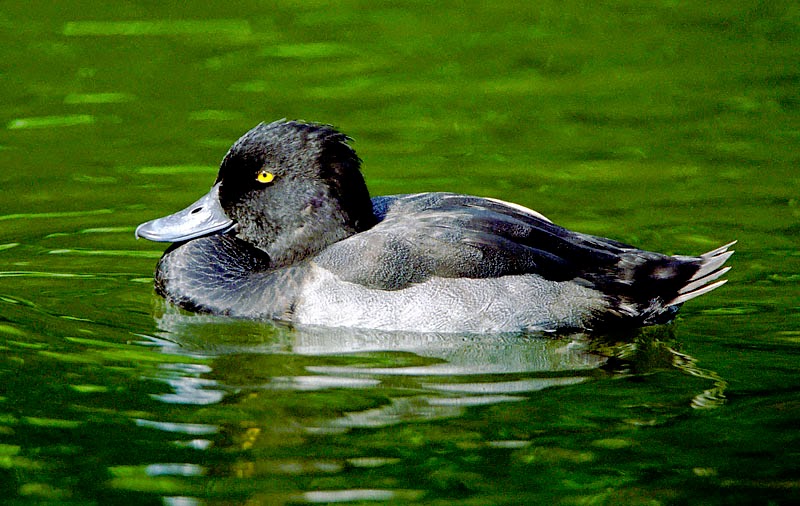
apparent Scaup hybrid, possibly Greater Scaup x Lesser Scaup, Eyebrook Reservoir (Leicestershire, UK), 10th November 2015 - copyright Andy Mackay
(photo ID: 2415)


This is a difficult bird!  I've included it under the two-Scaup heading but I'm by no means sure that is the correct ID, and acknowledge that others are leaning more towards a hybrid involving Tufted Duck (e.g. on Andrew Harrop's excellent blog), while others suspect it could be a pure Lesser Scaup.  Andy tells us that the pale subterminal band on the bill was more obvious in life than it is in the photos (more of which appear below) - and that is one good reason to consider Tufted Duck as a parent.  Many Tufted Duck x Scaup hybrids show more black on the tip of the bill, but apparently some don't, so that is not a strong enough reason to eliminate Tufted Duck from the equation.  Of more concern to me is the paleness of the back.  Typical Scaup x Tufted Duck has a much darker back lacking such coarse vermiculations as shown by this bird.  Again this does seem to be a variable feature on Tufted Duck x Scaup hybrids, however I have yet to see clear evidence that any Tufted Duck hybrid can show such a pale back as this.  A hybrid backcrossed with Scaup would be another matter, and that must remain a possibility for this bird (though a backcross to Lesser Scaup is surely beyond the bounds of reasonable possibility in the UK?).

The coarseness of the vermiculations suggest (to me at least) Lesser Scaup involvement, and indeed the bird looks a lot like a Lesser Scaup in many respects.  Andy tells me that in the field pure Lesser Scaup was never really a contender, but from the photos I think it would be a very easy conclusion to reach.  For Andy though, he saw it flap its wings twice and observed that the white bar definitely extended across the primaries as in Greater Scaup or Tufted Duck, and of course wrong for pure Lesser Scaup.

Andy also provided the following pertinent information:
"It was at least Tufted Duck size, perhaps slightly larger, and the head shape was nearer Greater Scaup, but usually with an obvious peak on the rear crown (really just a 'rough' patch of feathers interrupting the smooth curve). Also the head was strongly glossed green at all times, with just a hint of purple when seen head-on."
Worth noting that the new Helm guide to Wildfowl of Europe, Asia and North America by Sébastien Reeber has two Tufted Duck x Greater Scaup hybrids illustrated (one head only), one showing restricted black on the bill tip.  Both show a more obvious tuft than the Eyebrook bird had.  If they are the same birds illustrated in his 2002 article "Identification des fuligules et de leurs hybrides" (Ornithos 9: 177-209) then they were both darker-backed birds too.  Gillham & Gillham (Hybrid Ducks - a contribution towards an inventory, 1996) describe two male Tufted Duck x Greater Scaup hybrids as having bodies like Greater Scaup, but they suggest that these birds, which also had rounded heads and were as large as Greater Scaup) might have been backcrossed with Greater Scaup.


apparent Scaup hybrid, possibly Greater Scaup x Lesser Scaup (same bird as in photo ID 2415 above), Eyebrook Reservoir (Leicestershire, UK), 10th November 2015 - copyright Andy Mackay
(photo IDs: 2416-2418)


My first thought when I saw these photos was, "Why isn't this a Lesser Scaup?", so I was interested to receive an email from Steve Mlodinow, one of North America's leading birders and with a great deal of experience identifying hybrids, asking just that, or at least, "Besides the green on the head, why is not this a Lesser Scaup?" A green head sheen isn't enough to discount Lesser Scaup - I've personally seen green-headed birds in both UK & America, albeit eventually they showed purple under prolonged observation.  Steve went on to say,
"The head shape and bill are well within range for [Lesser Scaup], and I don't really see that bill coming out of a Greater Scaup x Tufted Duck hybrid... though I've not looked at known photos of that cross.  Ring-necked Duck x Scaup hybrids have far darker backs than this bird, and I would expect Tufted Duck x Greater Scaup to be similar."
So it seems Steve's interpretation of the photos is akin to mine.  But of course the answer to, "Why not a Lesser Scaup?" has to do with Andy's observations, rather than anything that is clearly visible in the photos.  Having said that, my own observations of both live birds and photos suggest that the wing-bar feature can be difficult to apply in poor or brief views (or imperfect photos).  Steve echoed these sentiments: "Depending on lighting, the wingstripe can be deceiving." But of course neither I nor Steve actually saw the bird, whereas Andy did, and asides from noting the possibility of error in recording wing-bar pattern in a general sense, we are in no position to question Andy's observations.  And it's worth remembering too that Andy thought the bill pattern did not look right for Lesser Scaup in life, showing too pale a subterminal mark.

Well, I shared this feedback with Andy and he's kindly supplied some more photos taken a few days earlier when the bird was more distant.  Here's what he said,
"The photos I sent might be misleading as regards the head shape, because in the field it really didn't suggest Lesser at all.  The attached three heavily cropped images were taken when I first saw the bird the week before, but much further away, and I think give a truer idea of the bird's usual head shape - much more evenly rounded and Greater Scaup-like.  I think if those were the only photos I'd got, no-one would even be mentioning Lesser as a possibility!

This is definitely the same bird, by the way - in the field I noted the occasional appearance of a slight tuft, strong green gloss to the head and that pale band behind the nail, all of which were also seen on the second occasion when it was much closer."
Well, this bird certainly does seem to be something of a mystery!  If nothing else it does provide a great example of why we should be cautious about identifying birds from photos...


apparent Scaup hybrid, possibly Greater Scaup x Lesser Scaup (same bird as in photo IDs 2415-2418 above), Eyebrook Reservoir (Leicestershire, UK), 1st November 2015 - copyright Andy Mackay
(photo IDs: 2450-2452)


Andy and I would both be interested to hear other people's views on this bird, so please let us know if you have any thoughts.


Tufted Duck Aythya fuligula
Greater Scaup Aythya marila
Lesser Scaup Aythya affinis

Saturday, 19 April 2014

Tufted Duck x Greater Scaup

Tufted Duck x Greater Scaup hybrid, Malmoe (Sweden), probably spring 2002 - copyright Carl Gunnar Gustavsson
(photo ID: 1077)


This bird is close to Tufted Duck in appearance but with its finely vermiculated dark grey (not black) back it can't be a pure Tufted Duck.  Although not proven its appearance seems to be consistent with Tufted Duck x Greater Scaup hybrid.  Carl Gunnar has learned that some ducklings were seen nearby a few years earlier which were suspected of being female Scaup x male Tufted Duck.


Tufted Duck x Greater Scaup hybrid (same bird as in photo ID 1077), Malmoe (Sweden), probably spring 2002 - copyright Carl Gunnar Gustavsson
(photo IDs: 1078-1081)


This female was seen in the same area the same summer.  The bill tip pattern doesn't seem quite right for a pure Greater Scaup and it's probably another hybrid.


probable Tufted Duck x Greater Scaup hybrid, Malmoe (Sweden), probably summer 2002 - copyright Carl Gunnar Gustavsson
(photo IDs: 1074-1076)


The next bird is probably the same male as shown above (photo IDs 1077-1081), but in partial eclipse plumage.


Tufted Duck x Greater Scaup hybrid (probably same bird as in photo IDs 1077-1081), Malmoe (Sweden), uncertain date - copyright Carl Gunnar Gustavsson
(photo IDs: 1082-1087)


The next bird is captive but spent the whole duration of Joern's visit asleep, preventing him from seeing the bill pattern or iris colour.  The only candidate parent species kept at the zoo were Common Pochard, Tufted Duck and Greater Scaup.  Joern explains:
"The general coloration is somewhat similar to Greater Scaup, but the mantle is a bit darker. There is a bump of feathers or a short crest at the rear of the head, indicating Tufted Duck involvement.  Tufted Duck x Common Pochard can look superficially similar, but in general the flanks of this type of hybrid are slightly greyish and the vermiculations on the mantle are less course than here.  Therefore in my opinion this bird is most likely a hybrid Tufted Duck x Greater Scaup."
probable Tufted Duck x Greater Scaup hybrid, Zoo Köln (Germany), 2nd November 2012 - copyright Joern Lehmhus
(photo ID: 0570)


It was interesting to see how the darkness of the upperparts on the next bird varied according to the angle of the bird and different light conditions.  When I first picked it up it looked as pale as a Scaup but quickly morphed into a darker-looking beast.  It never looked as dark as some of the photos above though.  Noticeably larger than Tufted Ducks it was accompanying making the Scaup parent Greater.  The vermiculations on the upperparts are not clearly visible in the photos but were easily seen in the field, albeit much less obvious than on either Scaup species, especially Lesser.


Tufted Duck x Greater Scaup hybrid, Lound Lakes (Norfolk/Suffolk border, UK), 7th March 2017 - copyright Dave Appleton
(photo IDs: 3130-3136)


Female Tufted Ducks with a lot of white around the bill and little or no tuft showing are often touted as possible Tufted Duck x Scaup hybrids (or even misidentified as pure Scaup) but in most cases they are just Tufted Ducks.  The bird below differed from these in that I got a good clear look at the head over a period of time and its feathers were ruffled and raised sufficiently for me to establish that it certainly did not have an elongated tuft, rather than this simply not being visible.  Moreover the structure seemed quite Scaup-like, although it was as small as a Tufted Duck.  At some angles the upperparts and flanks seemed to lack any grey feathering (although they were paler than on the accompanying Tufted Ducks) but at some angles there seemed to be a distinct greyish tone to upperparts and flanks.  Some photos seem to hint at an extensive dark tip to the bill as on Tufted Duck but in the field this seemed to be lacking - it certainly was not as obvious as it often is on Tufted Duck.

Unfortunately poor light, my longest lens being away for repairs and my general lack of technical skill mean that the photos I took are all quite poor.


probable Tufted Duck x Greater Scaup hybrid (with Pochard), Salhouse Broad (Norfolk, UK), 1st January 2013 - copyright Dave Appleton
(photo IDs: 0483-0487)


Next up are a male and a female on consecutive days:

Tufted Duck x Greater Scaup hybrid (with Tufted Ducks), Moellekrog (Denmark), 25th October 2004 - copyright Rasmus Strack
(photo ID: 0906)


Tufted Duck x Greater Scaup hybrid, Lake Esrom (Denmark), 26th October 2004 - copyright Rasmus Strack
(photo ID: 0905)


Joern Lehmhus has written about Tufted Duck x Greater Scaup hybrids in the German magazine Aves.  The text is in German but non-German speakers may still be interested as it's accompanied by a number of photos of Tufted Duck x Greater Scaup hybrids.  You can access the PDF of Aves 3 (2012) - the article starts on page 32 with section 2 on this hybrid beginning at page 35 - the five photos captioned "Reiherente x Bergente" are Tufted Duck x Greater Scaup hybrids.


Tufted Duck Aythya fuligula
Greater Scaup Aythya marila

Ferruginous Duck x Greater Scaup

captive probable Ferruginous Duck x Greater Scaup hybrid, Blakeney Collection (Norfolk, UK), 1st December 2012 - copyright Dave Appleton
(photo ID: 0432)


I have seen this bird on a number of occasions and have struggled with its ID.  When I first saw it it was with a Ferruginous Duck and a Greater Scaup and I suspected that it could be a hybrid between these two species, showing rich mahogany tones to the plumage which could come from Ferruginous Duck (but are not so strong to be certainly so) and a white patch round the bill suggestive of Scaup.  I've come up with various other ideas in the meantime but, with some help from Joern who has always favoured that ID, I am now back where I started.  The bird is bulky and broad-bodied - for a while that made me wonder if a Netta species could be involved (Rosy-billed Pochard have been kept there) but this is probably more likely to have come from Greater Scaup.


captive probable Ferruginous Duck x Greater Scaup hybrid (same bird as in photo ID 0432 above), Blakeney Collection (Norfolk, UK), 1st December 2012 - copyright Dave Appleton
(photo IDs: 0433-0436)


captive probable Ferruginous Duck x Greater Scaup hybrid (presumably same bird as in photo IDs 0432-0436 above), Blakeney Collection (Norfolk, UK), 4th December 2010 - copyright Dave Appleton
(photo IDs: 0437-0439)


captive probable Ferruginous Duck x Greater Scaup hybrid (presumably same bird as in photo IDs 0432-0439 above), Blakeney Collection (Norfolk, UK), 12th February 2011 - copyright Dave Appleton
(photo IDs: 0440-0441)


captive probable Ferruginous Duck x Greater Scaup hybrid (presumably same bird as in photo IDs 0432-0441 above), Blakeney Collection (Norfolk, UK), 12th March 2011 - copyright Dave Appleton
(photo IDs: 0442-0446)


captive probable Ferruginous Duck x Greater Scaup hybrid (presumably same bird as in photo IDs 0432-0446 above), Blakeney Collection (Norfolk, UK), 24th November 2013 - copyright Dave Appleton
(photo ID: 0447)


Ferruginous Duck Aythya nyroca
Greater Scaup Aythya marila