Showing posts with label Aythya collaris. Show all posts

Monday, 9 February 2015

Canvasback x (Redhead or Ring-necked Duck)

Canvasback x Ring-necked Duck or Canvasback x Redhead hybrid, Erie Reservoir, Boulder County (Colorado, USA), 4th February 2015 - copyright Steve Mlodinow
(photo ID: 1821)


Steve's photos of this one might not be his best but they were taken shortly before dusk on a cloudy day, so I think we can forgive him ;-)  He notes:
"The bill seemed to have some black around the base of the bill, and probably on the saddle [see photo ID 1819 below] as well as at the tip.  The bird looked paler than any of these photos indicated, with a distinctly darker head and upper neck.  No eyering."

Steve also tells us that there are photos of a male Canvasback x Redhead hybrid in the eBird collection that shows a bird "that alternates from the more Canvasback profile to that weird slope coming up of the bill and then flattening out on the crown".  He goes on to say:
"This bird has a bit more white around the face than I'd expect form this cross [Canvasback x Redhead].  It was with a Redhead and a Ring-necked Duck male, switching its attention from one to the other.  Its speculum was that of Ring-necked Duck/Canvasback/Redhead but not a scaup (or Tufted!).  My experience with Ring-necked Duck x Scaup hybrids is that the hybrids show the scaup parent's speculum.  The bird was smaller than the Redhead, so I wonder... Question, could this be a Canvasback x Ring-necked Duck?  I am actually leaning that way"


Canvasback x Ring-necked Duck or Canvasback x Redhead hybrid (same bird as in photo ID 1821 above), Erie Reservoir, Boulder County (Colorado, USA), 4th February 2015 - copyright Steve Mlodinow
(photo IDs: 1818-1820)


Canvasback Aythya valisineria
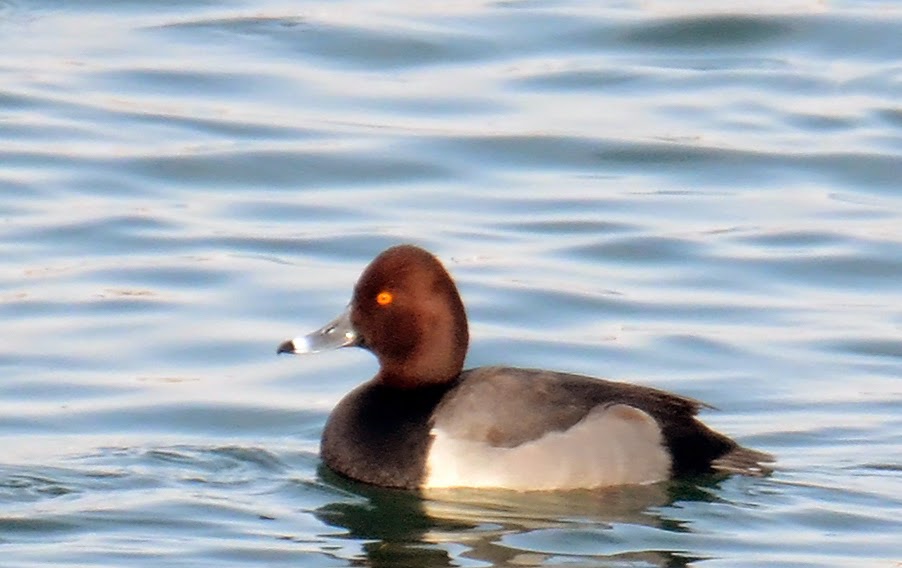
Redhead Aythya americana
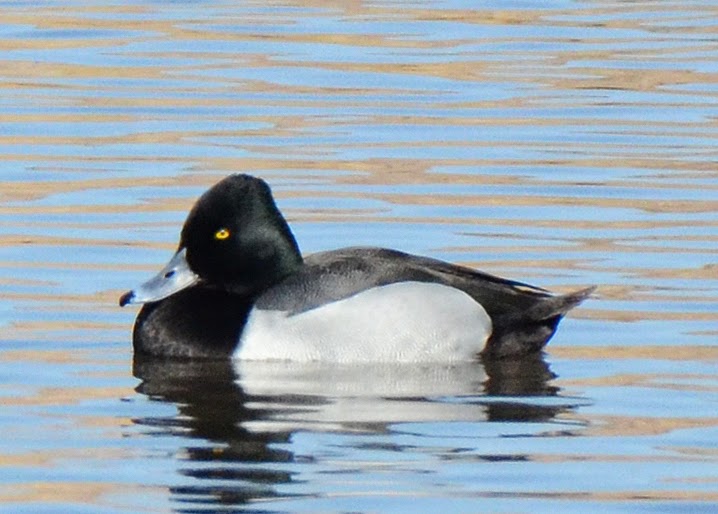
Ring-necked Duck Aythya collaris

Ring-necked Duck x Ruddy Duck

 
unidentified duck, perhaps Ring-necked Duck x Ruddy Duck hybrid, shot in South Carolina (USA), 'recently' (as at 1st February 2015) - copyright Austin Braddell
(photo ID: 1799)


Unusually I've been sent two sets of photos of hybrid ducks that have been shot in America.  The first one came from Don Terrell and Austin Braddock.  It possessed a stiff tail making Don wonder if Ruddy Duck was involved.  He'd wondered about Ring-necked Duck x Ruddy Duck but felt the narrow black bill was unexpected.  My initial thoughts were that it might instead be a hybrid between a dabbling duck species (Anas sp.) and a diving duck (probably Aythya) but the more I look at it the more I am leaning towards Ruddy Duck being involved after all.  Maybe Don was right with Ring-necked x Ruddy?  

It should be noted that cross-genera hybrids involving Stifftails are very unusual.  Only one, a Greater Scaup x Ruddy Duck hybrid, is listed Eugene M McCarthy's Handbook of Avian Hybrids of the World (listed as questionable but to be firmed up in the second edition - big thanks to Eugene McCarthy for getting in touch about that).  I've not seen any reference to any others (although I did once get an all-too-brief view of a bird I suspected may have been a Tufted Duck x Ruddy Duck hybrid).   The photo above does seem to show a very Ruddy-like stripe across the face, although this isn't obvious in the photos below.  The plumage with its mottled appearance below and dark back and upper wings are perhaps consistent with a Ruddy Duck hybrid - and of course the tail seems that way.  The pale around the eye and behind the bill, plus the pale band on the bill, are consistent with a Ring-necked Duck hybrid, and the bill shape is certainly more Aythya than Ruddy Duck.

Austin is hoping to get the bird mounted so may have an opportunity to get some spread-wing photos.  Perhaps that will help us resolve this conundrum.


 unidentified duck, perhaps Ring-necked Duck x Ruddy Duck hybrid (same bird as in photo ID 1799 above), shot in South Carolina (USA), 'recently' (as at 1st February 2015) - copyright Austin Braddell
(photo IDs: 1795-1798)


Ring-necked Duck Aythya collaris
Ruddy Duck Oxyura jamaicensis

Tuesday, 17 June 2014

Ring-necked Duck x Tufted Duck

Ring-necked Duck x Tufted Duck hybrid (with Tufted Ducks), Gavnoe (Zealand, Denmark), 18th March 2006 - copyright Rasmus Strack
(photo ID: 0907)


I'm sure Rasmus did the best that was possible given the distance from the bird, but I hope we soon have some closer shots of this hybrid before long...  But even at this distance there is enough to see that this is no ordinary Tufted Duck. Lars Michael Nelson who found this bird says it showed intermediate flank colour and head markings.  

This bird also showed a green head-sheen which may come as a surprise for a hybrid between two species which both normally show purplish head sheens (although they can appear green under certain light conditions).  In fact this is normal for Ring-necked Duck x Tufted Duck hybrids.  The head sheen colour is affected by the structure of the feathers, not just the pigments, so possibly an intermediate feather structure can reflect the light in such a way that the colour reflected is not intermediate?

Joern Lehmhus has written about Aythya hybrids in the German magazine Aves.  The text is in German but non-German speakers may still be interested as it's accompanied by a photo of Ring-necked Duck x Tufted Duck hybrid.  You can access the PDF of Aves 3 (2012) - the article starts on page 32 with section 5 covering this hybrid beginning at page 38 - the photo captioned "Reiherente x Ringschnabelente" (Abb. 28) is a Ring-necked Duck x Tufted Duck hybrid. 


Ring-necked Duck Aythya collaris
Tufted Duck Aythya fuligula

Saturday, 19 April 2014

Ring-necked Duck x Lesser Scaup

Ring-necked Duck x Lesser Scaup hybrid, Green Valley (Avra Valley) Wastewater Treatment Ponds, Pima County (Arizona, USA), 12th February 2013 - copyright Steve Mlodinow
(photo ID: 1206)


The bill tip pattern is very unusual on this bird with the black on the nail extending up the centre of the bill slightly but not along the sides at all - best seen in the face-on shot below.  Steve also notes the dark and fairly solid (but not black) back, even pale grey sides, duskier than that of Scaup but without white "shoulder" stripe of Ring-necked Duck.  The head shape is rather like Ring-necked Duck, and the head was consistently green which is apparently unlike other hybrids of this sort that Steve had seen.  However, it lacks anything in head size, body size, or head shape to indicate that the Scaup parent was Greater rather than Lesser.  Indeed a green head colour should not be taken to infer a green-sheened parent species as a green sheen is normal for Ring-necked Duck x Tufted Duck hybrids, in which both parent species normally show a purple sheen.


Ring-necked Duck x Lesser Scaup hybrid (with Ring-necked Ducks and Lesser Scaup, same bird as in photo ID 1206 above), Green Valley (Avra Valley) Wastewater Treatment Ponds, Pima County (Arizona, USA), 12th February 2013 - copyright Steve Mlodinow
(photo IDs: 1207-1210)


For the next bird Steve draws our attention to the mostly Ring-necked Duck head shape, the pale subterminal band on bill (like Ring-necked Duck) but the reduced pale band at the base of the bill.  The back color is intermediate between Ring-necked Duck and Lesser Scaup and in his experience the back colour, head shape and bill pattern are typical of this hybrid.  The bottom photo showing the stretched wing, with a sharp contrast between the white on the secondaries and grey on the primaries, provides confirmation that the Scaup parent is indeed Lesser Scaup and not Greater Scaup.


Ring-necked Duck x Lesser Scaup hybrid (with Lesser Scaup), Kersey, Weld County (Colorado, USA), 5th April 2012 - copyright Steve Mlodinow
(photo IDs: 1293-1296)


With the next bird (a female I presume) Steve didn't see the wing bar so the Scaup parent identity isn't fully confirmed, although Lesser Scaup is presumed.  Steve says he usually picks these hybrids out by the head shape which is like that of Ring-necked Duck but just a bit subdued.


presumed Ring-necked Duck x Lesser Scaup hybrid, Capitol Lake, Olympia (Washington, USA), 23rd January 2011 - copyright Steve Mlodinow
(photo IDs: 1481-1482)


On the next bird I think there are a number of pointers towards Ring-necked Duck parent as opposed to Tufted Duck, which was also considered.  On the bill the pale subterminal band is strong and on one or two of the photos there seems to be a hint of an indistinct pale line round the base of the bill, which could only come from Ring-necked Duck if a real feature as opposed to a trick of the light.  The flanks are sullied grey which we would not expect from a Tufted Duck hybrid and critically, I think, the white at the front of the flanks extends up in a point round the shoulder much like it does on Ring-necked Duck and more than it does on Tufted Duck (or either Scaup species).  Pete tells us that the mantle appeared slightly paler than it looks in the photos, with more contrast between that and the head and breast.  Apparently Lesser Scaup was the most numerous species in the 400-strong Aythya flock in which Pete found this bird, and that seems a good bet for the grey-backed parent although it is perhaps hard to be absolutely sure Greater Scaup is not involved.


probable Ring-necked Duck x Lesser Scaup hybrid (with Lesser Scaups), Suffolk County (New York, USA), 27th January 2016 - copyright Pete Morris
(photo IDs: 2665-2668)


Ring-necked Duck Aythya collaris
Lesser Scaup Aythya affinis

Ring-necked Duck x Ferruginous Duck

Ring-necked Duck x Ferruginous Duck hybrid - copyright Joern Lehmhus
(illus. ID: 0653)


Joern's drawing is based on photos of two birds from the web, one from England and the other without a location specified.  One of the two birds had totally black undertail coverts.  He has written about these in the German magazine Aves.  The text is in German but if you can read German it's worth accessing the PDF of Aves 3 (2012) - the article starts on page 32 with section 5 covering this hybrid beginning at page 38.

This next bird is rather different, chiefly in having darker flanks (more like Ferruginous Duck).  It also lacks much evidence of Ring-necked Duck in its head shape.  It wasn't submitted to us as a Ring-necked Duck x Ferruginous Duck hybrid and indeed that may not be the correct ID.  But to my eyes at least it has a prominent pale subterminal band on the bill and a hint of the white surround to the base of a bill (clearest in the head-on photo) which together are suggestive of Ring-necked Duck influence.

I wonder if the situation with this hybrid is analagous to that of Ferruginous Duck x Tufted Duck in which most males seem to have pale flanks (as in Joern's illustration of Ring-necked Duck x Ferruginous Duck, above) but some reportedly show darker more Ferruginous Duck-like flanks.  These birds are also more Ferruginous Duck-like in other respects (e.g. head colour).  Perhaps there are two types of Ring-necked Duck x Ferruginous Duck hybrids also, the more frequent one showing paler flanks and clear evidence of Ring-necked Duck in head shape and the other showing darker flanks and a less obvious head shape?  At the moment this is simply speculation - more evidence is needed before we can draw conclusions.  Here is the bird anyway, let us know if you have any thoughts about it.


possible Ring-necked Duck x Ferruginous Duck hybrid, Throckmorton Lagoons (Worcestershire, UK), 9th December 2006 - copyright Andy Warr
(photo IDs: 2433-2435)


Ring-necked Duck Aythya collaris
Ferruginous Duck Aythya nyroca

Redhead x Ring-necked Duck

Redhead x Ring-necked Duck hybrid, Siena Pond, Broomfield County (Colorado, USA), 27th December 2012 - copyright Steve Mlodinow
(photo ID: 1243)


Steve tells us that Scaup x Ring-necked Duck hybrids normally show less of a white terminal band on the bill and whiter sides, but of course the reddish hue on the head should rule out that possibility once seen.  Cathy was birding with Steve when he found this bird and she notes the maroon-coloured head, the darker back (compared to Redhead) and the more peaked head shape.  Apparently the tail feathers were also a shade darker than on Redhead.


Redhead x Ring-necked Duck hybrid (same bird as in photo ID 1243 above; with Redhead), Siena Pond, Broomfield County (Colorado, USA), 27th December 2012 - copyright Cathy Sheeter
(photo IDs: 1886-1887)


The flight views reveal further differences from Scaup hybrids - Steve points out that the entire speculum should be whiter in a cross with Greater Scaup and the secondaries/inner primaries should be paler in a hybrid with Lesser Scaup.

There is a photo of known (captive) Redhead x Ring-necked Duck hybrids on www.taxidermy.net.


Redhead x Ring-necked Duck hybrid (same bird as in photo ID 1243 and photo IDs 1886-1887 above; with Redhead), Siena Pond, Broomfield County (Colorado, USA), 27th December 2012 - copyright Steve Mlodinow
(photo IDs: 1239-1242)


Below is a second bird.  We can see that Redheads were present but Steve tells us there were no Ring-necked Ducks here.


Redhead x Ring-necked Duck hybrid (with Redheads), Loloff Reservoir, Weld County (Colorado, USA), 6th April 2015 - copyright Steve Mlodinow
(photo IDs: 2228-2230)


Redhead Aythya americana
Ring-necked Duck Aythya collaris