(photo ID: 1029)
Introduction
Intersex birds can look so different from normal examples of the species that observers often wonder whether they are seeing a hybrid. Some particularly share plumage features with specific hybrids, so this confusion is unsurprising.
I won't go in to much detail about what intersex means (mainly because I am not competent to do so) but with birds (and presumably many other life-forms) it's basically when a female bird begins to develop male features. I understand that this effects the genitalia but it is visibly manifest through changes in the bird's external appearance.
It's generally pretty rare, but not hugely so, and a careful observer is likely to find intersex birds from time to time.
How the external appearance changes
More study/research is required to fully understand this, and to that end please contribute any insights or experience you have that might help. However, based on what we have seen so far it seems that intersex female birds start off looking like females and gradually develop male features. It seems that the majority of the bird's plumage will change (assuming the species is sexually dimorphic) before the bare parts change, so a significant clue to the fact that we are dealing with an intersex is plumage that has clear male traits while the bill remains female-like, such as with the Mallards shown here.
intersex Mallard (same bird as in photo ID 1029 above), Malmoe (Sweden), 27th December 2008 - copyright Carl Gunnar Gustavsson
(photo IDs: 1030-1031)
intersex Mallard, Utah Pond, Aurora (Colorado, USA), 16th January 2015 - copyright Cathy Sheeter
(photo IDs: 1825-1827)
The next bird is more advanced, showing only traces of brown on the head but still sporting a fully female-like bill.
intersex Mallard, Pueblo City Park, Pueblo (Colorado, USA), 7th February 2015 - copyright Cathy Sheeter
(photo IDs: 1828-1829)
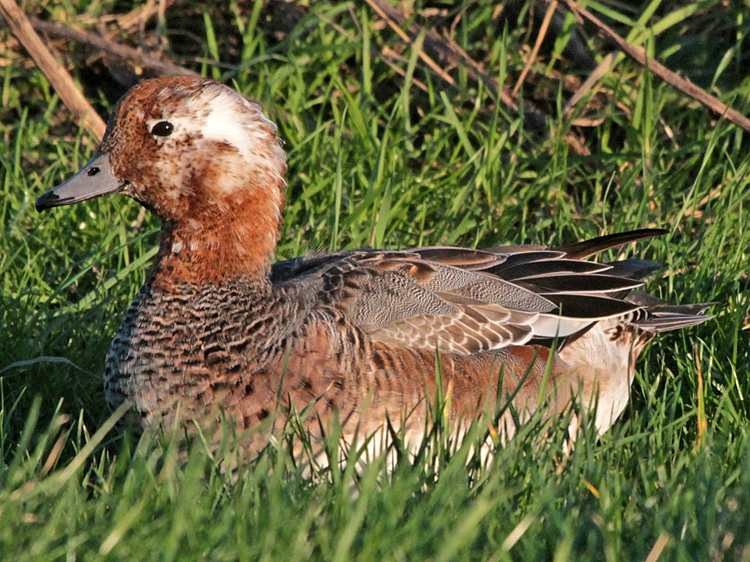
We have seen birds that have fully male-like bare parts (i.e. a yellow bill in a Mallard) and predominantly male-like plumage, save for a brown cheek. We have assumed such birds are advanced intersex. However, the notion that intersex birds gradually become more and more male-like has been challenged by some recent observations where a bird has been seen repeatedly over a number of years and its external plumage has not developed significantly. This Wigeon is an example - this photo was taken in 2012 and it hasn't changed much four years later (a later photo appears further down this page).
intersex Wigeon, Salthouse (Norfolk, UK), 1st December 2012 - copyright Dave Appleton
(photo ID: 3107)
If the next bird is an intersex female (and as always, comments are welcome) then it bucks the trend a bit in having a yellow bill yet retaining a fair bit of brown plumage (especially on the breast).
possible intersex Mallard (left, with normal Mallard), Colorado (USA), 25th January 2012 - copyright Cathy Sheeter
(photo ID: 1888)
In researching the bird above Cathy found photos of another individual with some resemblance. It had been photographed twice - in mid December 2007 it looked much like a female with a lot of green on the head and a few grey feathers in the body (photo
here) and by late January the following year it looked much more male-like save for a streaky brown breast like Cathy's bird (and a few other brown feathers). By then the bill still showed the pattern of a female but was starting to appear yellow (photo
here). Are we right in calling these birds intersex, or are they just first-winter males developing in a very unusual manner?
If you keep ducks, or if you have an opportunity to study particular birds over time, you may have an opportunity to document the way an intersex bird changes over the course of however many years it takes. Please get in touch if that's you! Maybe someone already has photos of a bird that has developed over successive moults? We would love to include them here.
Identification
The pale cheeked appearance of some intersex Mallards makes their plumage appear distinctly similar to that of several Mallard hybrids, such as Mallard x American Black Duck or some Mallard x Gadwall hybrids. However a male hybrid will show a male bill colour/pattern whereas most intersexes show a female-like bill. However caution is needed and some advanced individuals may be more difficult.
Similarly other birds with an unusual appearance, first suspected as being hybrids, may in fact prove to be intersex. For example the unusual appearance of this Pintail may have made many suspect it were a hybrid, but apparently it is simply an intersex bird.
intersex Northern Pintail, Hamburg (Germany), 9th April 2014 - copyright Joern Lehmhus
(photo ID: 1632)
And just to prove the point, I was looking through my old photos recently and came across some unresolved ones I'd forgotten about labelled "Pintail hybrid" which I have probably not looked at for 12 years. I now recognise it as being an intersex Pintail, not a hybrid.
captive intersex Northern Pintail, Blakeney (Norfolk, UK), 12th April 2004 - copyright Dave Appleton
(photo IDs: 2713-2714)
captive intersex Northern Pintail, Blakeney (Norfolk, UK), 7th November 2003 - copyright Dave Appleton
(photo ID: 2715)
Intersex birds may also resemble males in transition from non-breeding plumage to breeding plumage (or in the case of ducks transition in or out of eclipse plumage). Again the appearance of the bill (as well as the time of year) may be important clues as to the real cause of their unusual appearance.
Similarly intersex birds may be confused with immature males in transition from juvenile to adult plumage. This can be quite difficult to determine as juveniles may show female-like bills as well as female-like plumage in some species, so If time of year does not rule this out extra care must be taken.
(photo ID: 1028)
The above Mallard is a different individual to the bird photographed same day same place and shown above in photo IDs 1029-1031.
The following intersex Teal, or one very much like it, was identified as an unknown hybrid when it appeared a few miles along the coast 2-3 months before I photographed it. Despite having already written much of this page even I didn't recognise it as an intersex bird intially (thanks Joern for suggesting it), favouring an unusual drake in transitional plumage. But see how the flanks have a mixture of narrow and broad barring, the latter not present on either male or female Teal but also seen on intersex Pintails. Also interesting that the normally creamy yellow patches beneath the tail are almost white. Very similar birds appear online
here and
here.
intersex Eurasian Teal, Titchwell (Norfolk, UK), 27th June 2016 - copyright Dave Appleton
(photo IDs: 3063-3064)
Frequency of appearance - possible links to domestication or hybridisation
In general, intersex birds seem to be reasonably rare. Of course they will only be detected in species that are sexually dimorphic (i.e. where males and females look different) and they are most likely to be detected if the males look very obviously different from females. Most examples I have seen documented have been ducks, but the phenonemon is not restricted to wildfowl.
The Pheasant below was in an area containing numerous
tenebrosus variant Pheasants (the ones where the males are all-dark). Its body and wings were dark brown like a female Tenebrosus Pheasant but its head and breast more closely resembled that of a male. The time of year (April) ruled out any possibility that it could be a young male in transitional plumage so my presumption is that it must be an intersex. Unfortunately it was well hidden and I never managed to take a photo of the whole bird, and even when I managed the whole head and shoulders it was out of focus. I have personally seen one other presumed intersex Pheasant (not
tenebrosus) but didn't manage to obtain any photos.
presumed intersex Ring-necked Pheasant (var. tenebrosus), south of Wells (Norfolk, UK), 12th April 2011 - copyright Dave Appleton
(photo IDs: 1754-1756)
There is some anecdotal evidence to suggest that hybrid birds may be more susceptible to being intersex than other birds. For example with Mallard x Red-crested Pochard hybrids a high proportion of images we have encountered have been birds showing a mix of male and female features (although the sample size is too small to draw firm conclusions). Some of these have been very female-like but showed limited amounts of male-like plumage, whereas others, such as mine shown below, have been predominantly male-like in plumage but have shown a bill pattern that would be more expected of a female hybrid (more photos of this bird appear
here).
apparent intersex domestic Mallard x Red-crested Pochard hybrid, Cleethorpes Boating Lake (Lincolnshire, UK), 7th April 2012 - copyright Dave Appleton
(photo ID: 0377)
A related hypothesis is that domestic or other mutant variants of birds are also more likely to develop intersex characteristics. The fact that one out of two intersex Pheasants I've seen was
tenebrosus variant supports this hypothesis, but clearly much more data is required to test it properly. The fact that the majority of intersex duck records relate to Mallard may also support it, however many of them have resembled wild-type Mallards. That may just be because domestic variants of either gender often don't show features we associate with that gender of Mallard anyway, so intersexes are harder to detect. Abnormalities in wild-type birds, even if they have some domestic blood, are easier to spot.
Although this hypothesis is a long way from being established as fact, it would perhaps be unsurprising if intersex, as with any defect, should occur more commonly in birds that are genetically abnormal for other reasons. And now we seem to have another example... a possible link between intersex and leucism.
Intersex and leucism
I have now observed three different Wigeon which I believe to be intersex (two of them at least), and all three have showed abnormal white plumage behind the eye. OK, it was the white that drew my attention to them, and maybe I have seen lots more intersex Wigeon that I have overlooked as first-winter males (they can look very similar) but that all the male-plumaged Wigeons I've seen with white behind the eye have shown signs of being intersex is perhaps significant. I won't describe these at length here because I've already done so elsewhere - have a read of
this blog post if you're interested. More photos at that link but here are a small selection.
The first one resembles a first-winter male Wigeon, but has reappeared in a similar condition over several consecutive winters.
intersex leucistic Wigeon, Salthouse (Norfolk, UK), 23rd December 2015 - copyright Dave Appleton
(photo ID: 2805)
This one was more female-like but shows a few male features. Like the Salthouse bird it also shows abnormal dark barring in the breast and foreflanks - perhaps something similar going on there to the intersex Pintails that show dark barring on the flanks?
intersex leucistic Wigeon, Burnham Norton (Norfolk, UK), 2nd April 2016 - copyright Dave Appleton
(photo ID: 2806)
I passed this one off as simply a male, but males don't normally show dark markings in the breast like this - and like the two intersex birds above, so I suspect it is a more advanced intersex. Also present at this site the same day was a female-like bird with a white patch behind the eye, the likes of which I have seen several times at various locations. Maybe those are also intersex, but not so advanced that male features are evident externally?
possible advanced intersex leucistic Wigeon, Buckenham (Norfolk, UK), 25th January 2004 - copyright Dave Appleton
(photo ID: 2807)
Wigeon may not be the only species that links leucism with intersex -
this intersex Mallard seems to have quite a lot of white on the cheeks too. And what about all those Brent Geese with white speckling on their heads - are they intersex as well mabye?
Bilateral gynandromorphs
Bilateral gynandromorph is a condition whereby a bird (or other animal - there are some famous examples of butterflies with this condition) is split down the centre showing male features on one side and female on the other. Side on a bird will look either male or female, but front on it will look half and half. It appears to be very rare in birds, although of course you would not notice it in species where the two genders are alike. This House Sparrow is male down its left side but female down its right side.
bilateral gynandromorph House Sparrow, Finland, 18th February 2017 - copyright Henry Lehto
(photo IDs: 3029-3031)
Future study
Although not directly related to hybrid birds, the potential for misidentification as hybrids and the possibility that it's a condition that is more likely to occur in hybrids, makes this a topic that is relevant to the Bird Hybrids project. So we welcome contributions that would help further our understanding of the appearance and occurrence of intersex birds.
Further clarity on the condition itself - or conditions - would also be welcome. I have followed others in describing birds with mixed or changing gender characteristics as intersex, but is this correct, or am I perpetuating an inaccuracy? In humans, "intersex" is a general term to cover a variety of conditions in which someone has a reproductive or sexual anatomy that doesn't match typical definitions of male or female. This condition is, apparently, present at birth, although in some cases it may not become apparent until later, if at all. Sometimes birds that I and others call intersex are described by other people as experiencing a decline in estrogen levels - does that refer to something different to intersex, or is it simply a consequence of one or other condition that comes under the catch-all description of intersex? Most of the information I have read about intersex birds involve females developing male characteristics but in a comment I read recently (at the end of
this blog post, in Spanish) someone claimed that it happens the other way round too - a male suffering an injury to its reproductive system by trauma or disease may develop feminine traits. I have often wondered if this is the case, but does anyone know of examples where this has been seen in birds? And if it is a result of an injury or event later in the bird's life is it still correct to describe it as intersex which, in humans, is supposed to be from birth?
In the meantime, here are some more photos of intersex (assuming that is the correct term) birds. Itziar has written (in Spanish) about the first one in his
blog post.
intersex Mallard, Plaiaundi (Guipúzcoa, Spain), January 2016 - copyright Itziar Gutierrez
(photo IDs: 2716-2717)
Another intersex Pintail here - Ed informs me that this bird has returned in successive winters:
intersex Northern Pintail, Mistley (Essex), date(s) not given - copyright Ed Keeble
(photo IDs: 2718-2720)
And another Pintail...
intersex Northern Pintail, Gallinas, San Rafael (California, USA), 5th January 2017 - copyright Len Blumin
(photo ID: 2927)
And more Mallards:
intersex Mallard, Nedre Leirfoss, Trondheim (Norway), 27th March 2017 - copyright Håkon Lasse Leira
(photo ID: 3186)
intersex Mallard, Radipole Lake (Dorset, UK), 15th-17th October 2016 - copyright Philip Ridsdale
(photo IDs: 3094-3095)
intersex Mallard, Beetley (Norfolk, UK), 26th December 2013 - copyright Dave Appleton
(photo IDs: 1757-1758)
intersex Mallard, Bintree Mill (Norfolk, UK), 23rd April 2009 - copyright Dave Appleton
(photo IDs: 1759-1761)
intersex Mallard, Lewiston Levee Ponds, Clearwater River, Lewiston, Nez Perce County (Idaho, USA), 24th January 2015 - copyright Keith Carlson
(photo ID: 2016)
intersex
Mallard, Lewiston Levee Ponds, Clearwater River, Lewiston, Nez Perce
County (Idaho, USA), 21st November 2015 - copyright Keith Carlson
(photo IDs: 2306-2307)
intersex
Mallard, Boultham Mere (Lincolnshire, UK), 17th February 2016 - copyright Dean Nicholson
(photo IDs: 2773-2775)
Eurasian Wigeon Anas penelope
Mallard Anas platyrhynchos
Northern Pintail Anas acuta
Eurasian Teal Anas (crecca) crecca
Red-crested Pochard Netta rufina
Ring-necked Pheasant Phasianus colchicus
Tenebrosus Pheasant Phasianus colchicus var. tenebrosus
House Sparrow Passer domesticus


%2BL.JPG)
%2BL.JPG)
%2BL.JPG)



%2C%2BRawhall%2BGPs%2C%2B26-Dec-13%2B(A)%2B(2)%2BL.JPG)
%2C%2BRawhall%2BGPs%2C%2B26-Dec-13%2B(A)%2B(1)%2BL.JPG)
.JPG)
%2BL.JPG)
%2BL.JPG)


